The first cold evening of fall always brings the same question: you’re ready to light a fire, you reach into the fireplace, and suddenly you’re not sure whether that lever means open or closed. It’s one of the most common questions we hear from homeowners across Toronto, and it matters more than it seems. A closed flue sends smoke straight into your living room, and a flue left open all winter lets warm air escape up the chimney.
Since this is Fire Prevention Week, it’s a good time to get it right. Here’s how to find your damper, open and close it, and check that it’s working before your first fire of the season.
Flue vs. Damper: A Quick Clarification
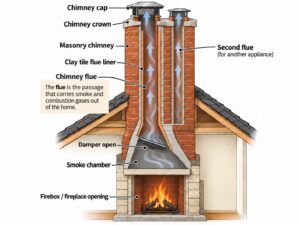
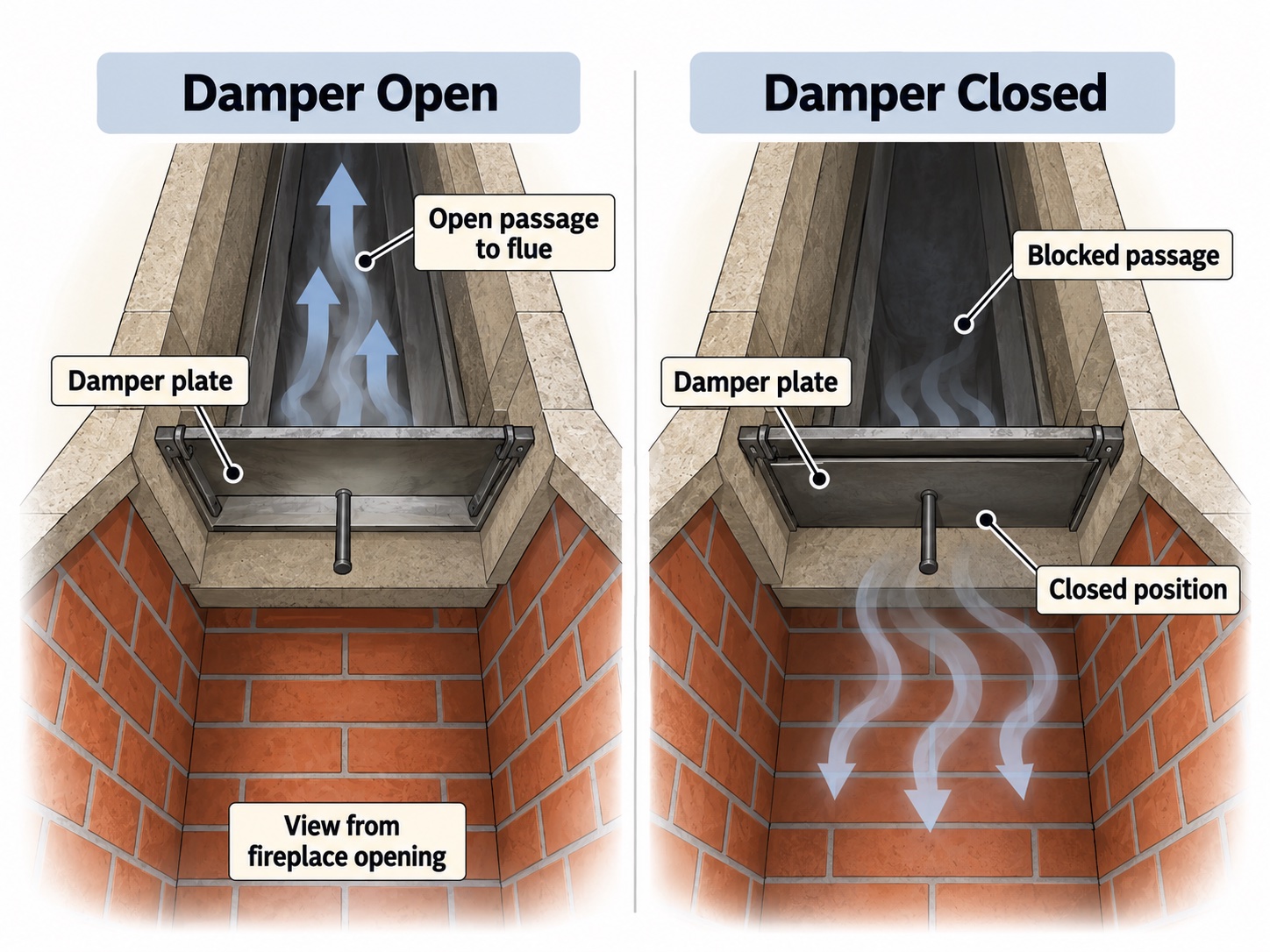
People often say “open the flue,” but what you’re actually opening is the damper. The flue is the passage inside your chimney that carries smoke and gases out of your home. The damper is the metal plate that opens and closes that passage.
When the damper is open, smoke can rise and exit. When it’s closed, it blocks the flue so heated air from your home doesn’t escape and helps prevent cold air, rain and debris from entering your home through the fireplace opening.
Step 1: Figure Out Which Type of Damper You Have
Most fireplaces in Toronto homes have one of two types.
Throat damper (inside the fireplace)
This is the most common type, especially in older homes. It sits just above the firebox, at the base of the chimney. You’ll usually control it with one of these:
- A lever or handle that you push, pull or slide. It’s often at the top front of the firebox.
- A rotary knob or crank on the fireplace face or just inside the opening.
- A poker-style handle that hooks into notches to hold the damper in position.
Top-sealing damper (at the top of the chimney)
These sit on top of the chimney and are controlled by a long chain or cable that hangs down into the firebox. They seal much more tightly than throat dampers, which is why many homeowners upgrade to them. They also keep out rain and animals when closed.
Step 2: How to Open a Chimney Flue
Always open the damper before you light the fire, never after.
- For a lever: Put on a pair of gloves (the metal can be dirty or sharp). Push or pull the lever all the way to its stop. On many models, pushing toward the back of the firebox opens it, but it varies, so use the check in Step 3 to confirm.
- For a rotary knob: Turn the knob to the fully open position. The direction varies by model, so check the damper’s position rather than relying on which way the knob turns. Older rotary dampers can be tricky and the parts can separate, so never force a knob. Usually a half turn will do it; use a flashlight or your phone to check at the top of the firebox if you’re not sure if it’s open.
- For a top-sealing damper: Unhook the chain from its bracket and release the chain carefully. A spring at the top of the chimney pulls the damper open.
- For a poker-style handle: Lift it out of the notch, push it into the open position and set it in the notch that holds it there.
If the handle won’t budge, don’t force it. Rust, creosote buildup or a warped plate can seize a damper, and forcing it can break it. That’s a job for damper repair.
Step 3: How to Tell If Your Chimney Flue Is Open
Not sure which way is open?
The flashlight test. Shine a flashlight up past the damper. If you can see up into the chimney (or daylight at the top), it’s open. A small mirror can help if you can’t see the plate directly. If you see a flat metal plate across the opening, it’s closed. A lot of people also use the front facing camera on their phone.
If the damper is open but smoke still comes back into the room after it warms up, the problem may be a blockage or a draft issue. Discontinue use and have a professional inspect it before using the fireplace again.
Step 4: How to Close a Chimney Flue
Closing the damper is simply the reverse of opening it: move the lever, knob or handle to the opposite position, or pull the chain on a top-sealing damper down and hook it onto its bracket.
The more important question is when to close it.
When to Close the Chimney Flue
Close the damper only when the fire is completely out and the ashes are cold. That often means waiting until the next morning.
Closing it too early is dangerous. Smouldering embers still produce smoke and gases, and with the damper shut, that gas has nowhere to go but into your home. If you’re unsure, leave it open a little longer. A few hours of heat loss is not worth the risk.
A good routine:
- Open the damper before lighting the fire.
- Keep it fully open the entire time the fire is burning.
- Leave it open overnight until the ashes are cold. Or, at the end of the fire, shovel the ashes into a metal bucket and bring it outside. Then close the damper.
- Close it once the fireplace is cool, and keep it closed when you’re not using the fireplace.
Keeping it closed between fires matters in a Toronto winter. An open damper acts like an open window, letting warm air escape and cold air in.
What About Gas Fireplaces?
Gas fireplaces and gas log sets have different venting requirements depending on their design. Many gas log sets installed in wood-burning fireplaces require the damper to stay permanently open, and some are clamped open on purpose so it can’t be closed by accident. Never close the damper on a gas fireplace unless the manufacturer’s instructions say it’s safe. If you’re not sure how your gas fireplace is set up, have it inspected.
Signs Your Damper Needs Attention
A damper that doesn’t open, close or seal properly is more than an inconvenience. Watch for these signs:
- The handle is stuck, loose or spins without moving the plate.
- The damper won’t close fully, or you feel a cold draft even when it’s closed.
- You see rust flakes or debris falling into the firebox.
- You hear rattling or banging in windy weather.
- Smoke continues to enter the room after the fire is established, even with the damper fully open.
A worn-out throat damper can often be repaired, or replaced with a top-sealing damper that seals more tightly and doubles as a rain and animal barrier.
Get Your Fireplace Ready for the Season
Knowing how to use your damper is one part of fireplace safety. The other is making sure the chimney itself is clean, clear and in good repair before you light the first fire. Annual chimney maintenance includes an inspection to check for damage, blockages and damper problems, along with sweeping as needed to remove creosote and other deposits.
Ontario Fire Code section 2.6.1.4 requires inspections at intervals no greater than 12 months, when an appliance is added and following a chimney fire. Section 2.6.1.5 requires cleaning as often as necessary.
Once that’s done, you’re ready for a cozy, smoke-free fire.
A1 Quality Chimney has been serving homeowners across Toronto, Mississauga, Vaughan, Markham and Brampton for over 40 years. Our WETT-certified technicians can sweep your chimney, check your damper and repair or replace it if needed.
Damper stuck, or not sure your fireplace is ready? Call A1 Quality Chimney at (416) 231-6560 or book online to schedule your sweep and damper check before your first fire.